Product Overview
Hazardous Area Heating
Explosive Atmospheres & Hazardous Area Electrical Heating Products
International Distributor, World Class Service
We are acknowledged industry experts in providing Electrical Heating Solutions for explosive atmopheres – we are partners with world leading manufacturers including EXHEAT, Thermon, Hazloc, Chromalox and Emerson.
To fulfil the requirements of our global client base, we can supply explosion-proof heating equipment with cross border certifications such as ATEX, IECEx and EAC-EX as well as country specific certifications certified for use in Zone 1 & 21 (Gas) and Zone 2 & 22 (Dust).
- Water Heaters
- Line Heaters
- Immersion Heaters
- Air Warmers & Fan Heaters
- Portable Heaters
- Drum Heaters
- IBC Container Heaters
- Gas Bottle Heaters
- Heated Hoses
- Trace Heating
Hazardous Areas Explained
There are many gases, mists, vapours and dusts that can form explosive atmospheres when mixed with air and exposed to a source of ignition – commonly referred to as a hazardous area zone classified according to the ATEX Directive.
Hazardous area classifications are used to identify and categorize the presence or potential threat of gases in a working area and are specified as Zone 1, Zone 2, Zone 21 and Zone 22 according to the ATEX Directive.
The classification and designation of an area as hazardous enables the correct precautions to be taken over sources of ignition in order to prevent fires and explosions. Hazardous area classification should always be carried out as part of a work place risk assessment.
When assessing the level of risk, hazardous and non-hazardous area classification should be carried out systematically and should be used to determine if hazardous areas exist and to then assign zones to those areas.
The risks from not using the appropriate or properly specified and certified equipment in the wrong areas or zones can be catastrophic with explosion risks endangering personnel and plant.
The Dangerous Substances and Explosive Atmospheres Regulations 2002 (DSEAR) provide a specific legal requirement to carry out a hazardous area study, and document the conclusions, in the form of zones.
Hazardous Areas Explained
Hazardous areas are classified into the following zones according to the concentration levels of flammable gas and the explosion risk potential:
Gases, Vapours And Mists
Zone 1 – Zone 1 hazardous areas are considered to be a place in which an explosive atmosphere consisting of a mixture with air of dangerous substances in the form of gas, vapour or mist is likely to occur in normal operation occasionally.
Zone 2 – Zone 2 hazardous areas are classified as a place in which an explosive atmosphere consisting of a mixture with air of dangerous substances in the form of gas, vapour or mist is not likely to occur in normal operation but, if it does occur, will persist for a short period only.
Dusts
Zone 21 – A place in which an explosive atmosphere in the form of a cloud of combustible dust in air is likely to occur in normal operation occasionally.
Zone 22 – Zone 22 hazardous areas are a place in which an explosive atmosphere in the form of a cloud of combustible dust in air is not likely to occur in normal operation but, if it does occur, will persist for a short period only.
Equipment that is suitable for use in hazardous areas or that has been specifically manufactured for that purpose will typically have an ATEX hexagon marking on for easy identification and in many cases this marking will include a temperature rating expressed as a “T” marking and sometimes a gas group.
These indicate limitations of safe use. Employers and those installing equipment should consider the marking and documentation provided with “Ex” equipment when it is being installed.
Hazardous Area Temperature (T) Ratings
In addition to direct ignition sources, hazardous area rated equipment must also meet relevant temperature ratings in order to be classified as safe for use. The temperature should be considered at which a mixture of vapour, gas and dust would ignite and become a self-sustaining reaction in the area in which the equipment would operate.
This temperature (T) class rating refers to the maximum outside temperature equipment can reach and is based upon the auto-ignition temperature of gases.
Exheat
Some Typical Electrical Heating Applications
Process Heating
Specialist Distributors of Hazardous Area & Explosion Proof Equipment with IECEx & ATEX Certifications to the onshore and offshore oil, gas, petrochemicals and process industries.
Key Product Categories: Control Panels | Plugs & Sockets | Isolators | Enclosures & Junction Boxes | Lighting | Control Stations | Motor Starters | Heat Trace Cables & Systems | Gas Detection & Detectors | Fire Detection & Detectors | Heat Detectors

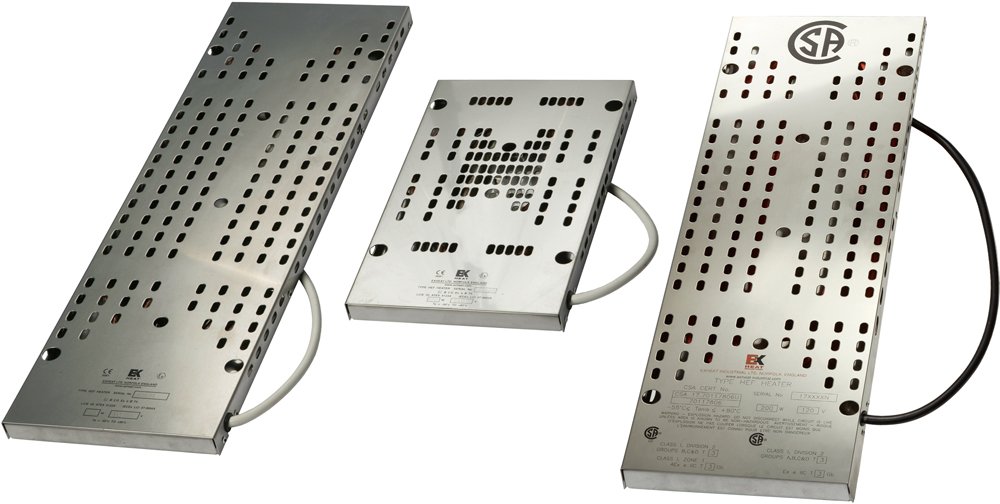 ATEX Electric & Process Heaters