Product Overview
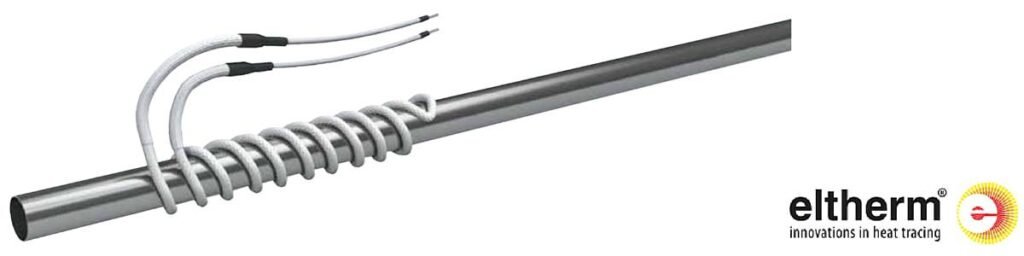
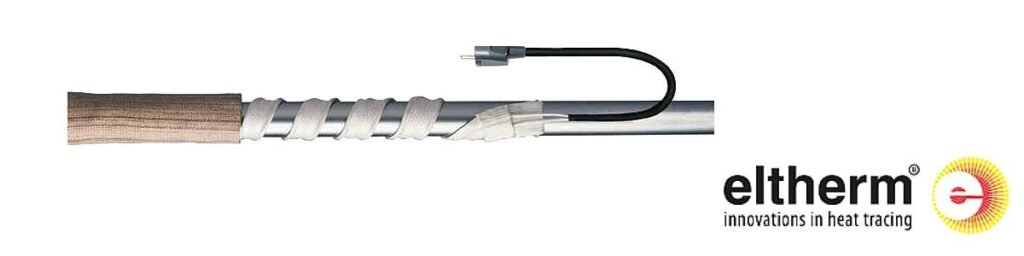
Eltherm ELK-Q high temperature heating cable and tapes provide process temperature maintenance and frost protection to vessels, pipes, valves and small components up to 900° Celsius.
Please Note: This product has been discontinued. Please Contact our team for an alternative!
Specification
- Nominal Supply Voltage : 230V
- Maximum Output : 175 w/m
- Maximum Operating Temperature : 900ºC
- Minimum Installation Temperature : Not restricted
- Diameter: 4mm
- Minimum Heater Cable Bend Radius: 5 x outer diameter
- Insulation : Quartz Textile
- Cold Lead Length (Both Ends) : 1.2m without plug
- Moisture Proof : No
- Protection Class: Depending on installation
- Manufactured According To : DIN VDE 0721 T2
- Final Inspection According To: DIN VDE 0721 T2, 1.5kV AC – 1 min
- Heating Cable Type : High Temperature Heating Cable
high temperature Heating Cable Selection Table – Eltherm ELK-Q
Contact our team for technical guidance, heat loss calculations for pipework systems and optimum specification of the correct trace heater cable for your application.
High temperature heating cable application : frost protection and process heating.
Other lengths of ELK-Q high temperature heating cable are available upon request.
Resistance Tolerance: +/- 5%
Lengths tolerance ± 2%, max ± 0.25m
Eltherm ELK-Q – Applications
- Heat tracing on glass, quartz and ceramic devices
- Devices and systems with high output needs
- Laboratory & research applications
Eltherm ELK-Q heating cables provide temperature maintenance and frost protection to pipework and mechanical services in all industries – typical applications include industrial and hazardous area heating of process pipework, instrument lines and storage tanks to maintain viscosity or prevent frost damage as an integral work-task of plant Winterisation.
Resistance Heating Cables
Eltherm resistance heating cables are manufactured from a high-resistance heating conductor, PTFE insulated with protective braid and fluoropolymer outer jacket. Powered at specific voltage the resistance heat generated by the conductors provides electrical trace heating to pipes and vessels. Resistance heating cables will “burn-out” if overlapped unlike self-regulating trace heating cables.
High temperature resistance heating cables insulated with glass fibre provide electrical heating up to 800° Celsius.

 Constant Wattage Cables | Resistance Heating Cables & Heating Tapes