Product Overview
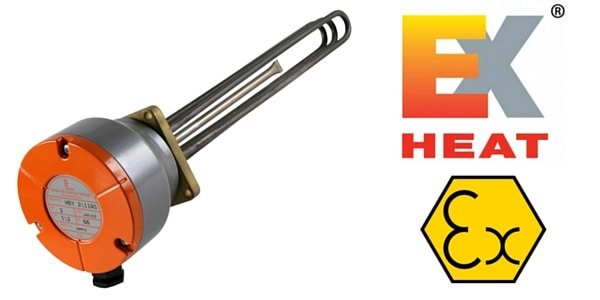
Immersion heaters for Zone 1 and Zone 2 classified hazardous areas provide flameproof heating for gases, oils, heat transfer fluids and corrosive solutions – this includes Zone 1 / Zone 2 (Gas) or Zone 21 / Zone 22 (Dust) or Class I, Division 1 and Division 2.
The immersion heater range can also be used in other applications including boiler equipment, process heating equipment, hot water storage tanks and heat transfer systems.
Typically manufactured from milled 316 stainless steel with weatherproof protection to IP66, ATEX heaters can also be provided with a choice of built in process temperature sensors.
Immersion heaters are submerged in water, oils, solvents, process solutions, molten materials and gases where the heater element releases all their heat within the fluid which makes them nearly 100% energy-efficient. Immersion heaters are offered in a wide variety of sizes, kilowatt ratings, voltages, terminations, sheath materials and accessories – we can produce custom engineered heaters for a specific application.
Contact our experts – place an order or find out more about our complete range of ATEX Immersion Heaters for your operations. We provide technical advice, quotations and fast worldwide delivery for both UK & Export projects.
EXHEAT Immersion Heater Element Types & Specifications
Hazardous Area Electrical Heating Product Overview
- Standard Flameproof Immersion & Tank Heaters – delivered from stock overnight
- Custom Engineered Flameproof Immersion & Tank Heaters – designed and delivered on short manufacturing lead times
- Heat Output 100W to 150W
- Fitted with industry flange connections or a threaded boss in variety of materials
- Immersion heaters for direct immersion into process fluids – rod/hairpin, ceramic core or cartridge-type heating elements
EXHEAT Heaters
EXHEAT Industrial offers fast-track electrical heating and process solutions suited to the diverse requirements of the industrial, non-hazardous and hazardous area industry sectors – providing the most extensive range of engineered electrical heating systems including:
- Hazardous area air warmers, enclosure heaters and industrial convector and fan heaters
- Space heaters, radiators, convector and fan-type heaters designed for smaller enclosures/cabinets or larger room/containers
- Immersion heaters for direct immersion into process fluids – rod/hairpin, ceramic core or cartridge-type heating elements
- Line heaters providing clean, safe and efficient heating for bulk liquid (corrosive/non-corrosive) flow applications in hazardous areas
- Weatherproof and flameproof industrial sensors/controls and thermostats integrated with EXHEAT heaters
- Industrial, baptistery and portable immersion heaters
- Heating elements (rod, cartridge and core type)
- Flameproof instrument housing and transmitters
- ATEX Zone 1 Zone 2 (Gas) & Zone 21 22 (Dust) Explosive Atmospheres
- Also | ATEX Fans (Portable Ventilation)
Selecting an Immersion Heater
Most electrical heating requirements can be solved by converting the heat requirement to its equivalent electrical power. Whatever the application the method for determining the power requirement considers the following.
Properties of the Material to be Heated – it is important to know the type and quality of the fluid being heated. For example, if the fluid is water, is it clean or contaminated or potable? Acids cause corrosion and insulating buildup on the heater sheath which can cause overheating and heater failure. If the fluid is thick and viscous oil, it requires a low watt density, whereas light oil could tolerate sheath watt densities to 30 W/sq. in. to 40 W/sq. in. – avoiding coking by considering the oils viscosity, specific heat and thermal conductivity.
Startup and Maximum Operating Temperatures – in essence, this is related to the temperature difference (delta T) between startup and operating conditions.
Maximum Flow Rate of the Material being Heated – this factor determines the wattage required. The minimum flow rate also might be required to help determine the watt density requirements. Too low a flow rate and too high a watt density can lead to excessive coking or excessive sheath temperatures in oil applications.
Cycle Time – the longer the startup time allowed, the lower the kilowatt requirement.
Mass of the Heated Material – this determines kilowatt requirements for startup.
Characteristics of the Containing Vessel – the weight determines the kilowatt requirement for startup. Vessel dimensions and presence of a cover determine heat loss. The vessels material of construction affects heater choice and mounting configuration. Heaters for pressurized vessels can bear the ASME code stamp.
Insulation – insulation thickness and properties affect heat loss from the vessel. Mineral-insulated cable or heat tracing cable compensates for losses from connecting piping.
Temperature Monitoring and Control – sensing and control methods and locations depend on the precision requirements for the process and heater sheath temperatures. For example, a simple freeze protection application might require only a mechanical bulb and capillary-type thermostat. For more precise measurement and control, a thermocouple or RTD might feed a PLC. A high-limit sensor on the sheath prevents overheating and premature failure or can determine if there is excessive contaminant buildup.
Environmental Conditions – ambient temperature and wind conditions can affect heat loss and should be taken into consideration when calculating kilowatt requirements. Hazardous, corrosive and explosive atmosphere environments are important factors.
Sizing the heater
The basic steps in sizing an immersion heater involve calculating the following:
- Power required for heating of the fluid and the tank. Use standard heat-transfer equations to calculate the fluid heating requirement
- Power required to heat the fluid during the operating cycle
- Heat required to melt or vaporize materials during initial heating
- Heat required to melt or vaporize materials during operating cycle
- Heat losses by standard equations
- Total startup power requirements. The results of steps 1 and 3 are added together and an appropriate safety factor is applied
- Total operating power requirements. The results of Steps 2, 4 and 5 are added and the safety factor applied
- Watt density. Calculate the total wattage divided by the active heater surface area based on the length of heater element immersed in the fluid, the surface area per inch, and the total number of heater element lengths
- Tank Heating – core and cartridge element immersion heaters provide hazardous area tank heating with exact control of liquid temperature, virtually 100% energy efficiency and ensuring a reliable and fast heat up time for water, solvents, molasses, syrups and petroleum products.
- Glycol Reboilers – hazardous area heaters are installed within the reboiler to thermally regenerate glycol – providing a clean, efficient controllable heat source with controlled sheath temperatures so as not to burn the glycol.
- KO Drums – electric heaters increase temperatures of separated liquids – a vapour-liquid separator may also be referred to as a flare KO drum, flash drum, knock-out drum, knock-out pot, compressor suction drum or compressor inlet drum.
This photograph highlights the challenges of servicing the worldwide oil and gas industry – barge delivery of a knock-out drum fighting through a waterway frozen by the polar vortex. From Saharan deserts to Arctic tundra the combined challenges of temperature extremes, potentially explosive atmospheres and harshest operating environments place significant importance upon the specification of equipment in accordance with international classifications.
Some Typical Electrical Heating Applications
Process Heating Applications
Specialist Distributors of Hazardous Area & Explosion Proof Equipment with IECEx & ATEX Certifications to the onshore and offshore oil, gas, petrochemicals and process industries.
Key Product Categories: Control Panels | Plugs & Sockets | Isolators | Enclosures & Junction Boxes | Lighting | Control Stations | Motor Starters | Heat Trace Cables & Systems | Gas Detection & Detectors | Fire Detection & Detectors | Heat Detectors

 Hazardous Area & Process Heating For Zone 1 & Zone 2 Locations