If you import electrical equipment from outside the EU — luminaires, distribution boards, power supplies, generators — you take on legal responsibilities. The CE marking on the product is the manufacturer’s declaration that it complies with EU legislation, but the importer must verify that the manufacturer has done its job. This checklist summarises what to look for. It is a practical overview, not legal advice; for specific cases, consult a notified body or a compliance specialist.
Which EU rules typically apply?
- Low Voltage Directive (LVD) 2014/35/EU – electrical equipment designed for use between 50 and 1000 V AC or 75 and 1500 V DC.
- EMC Directive 2014/30/EU – electromagnetic emissions and immunity.
- RoHS Directive 2011/65/EU (as amended) – restriction of hazardous substances in electrical and electronic equipment.
- Ecodesign rules – for products such as light sources, motors and power supplies.
- Machinery – the Machinery Directive 2006/42/EC, to be replaced by the Machinery Regulation (EU) 2023/1230, which applies from January 2027.
- ATEX Directive 2014/34/EU – for equipment intended for explosive atmospheres.
- For cables installed permanently in buildings, the Construction Products Regulation also applies, in addition to the LVD and RoHS (Declaration of Performance and Euroclass) — see our CPR guide.
The documents to request
- EU Declaration of Conformity (DoC) – naming the manufacturer, the product, every applicable directive or regulation and the harmonised standards used, signed and dated.
- Test reports – to the harmonised standards listed on the DoC (for example EN 60598 for luminaires, EN 61439 for low-voltage switchgear assemblies, EMC standards such as EN 55015 or EN IEC 61000 series).
- Technical documentation – the manufacturer must keep it for 10 years and make it available to authorities on request. As an importer, make sure you can obtain it.
- RoHS and REACH declarations – see our guide to RoHS, REACH and WEEE.
- Instructions and safety information in the language(s) required by the member states where the product is sold.
Importer obligations in short
- Check that the conformity assessment has been carried out, the technical documentation exists, the product bears the CE marking and is accompanied by instructions.
- Indicate your name, registered trade name or trademark and postal address on the product, or where that is not possible on the packaging or accompanying document.
- Ensure storage and transport do not compromise compliance.
- Keep a copy of the DoC for 10 years.
- Take corrective action and inform authorities if you have reason to believe a product is not compliant.
Since the Market Surveillance Regulation (EU) 2019/1020, many CE-marked products may only be placed on the EU market if there is an economic operator established in the EU (manufacturer, importer, authorised representative or fulfilment service provider) responsible for compliance information.
Red flags when checking documents
- A “CE certificate” issued by a company that is not a notified body for a directive that does not require one — the LVD and EMC directives are normally self-declared by the manufacturer.
- A DoC that lists outdated directives or standards.
- Test reports for a different model or for a product with different components.
- Missing manufacturer address or product identification.
- Labels that differ from the documents.
Examples by product
A LED panel or a high bay luminaire typically needs LVD, EMC, RoHS and Ecodesign compliance with EN 60598 test reports. A modular distribution board is assessed against the EN 61439 series. A diesel generator set involves machinery rules, EMC, noise and engine emission requirements — a more complex file.
How Wesourcia supports compliance
We check DoCs, test reports and labelling before we ship to European customers, and we can organise pre-shipment inspections. Explore our electrical equipment or request a quote stating the market where the product will be sold.
Frequently asked questions
Who issues the CE marking?
For most electrical equipment under the Low Voltage and EMC directives, the manufacturer declares conformity and affixes the CE marking. A notified body is only required for certain products and directives.
How long must the Declaration of Conformity be kept?
Manufacturers and importers must keep the EU Declaration of Conformity and have access to the technical documentation for 10 years after the product is placed on the market.
What must an importer put on the product?
The importer’s name, registered trade name or trademark and postal address must appear on the product, or where that is not possible on the packaging or accompanying document.
Products mentioned in this article
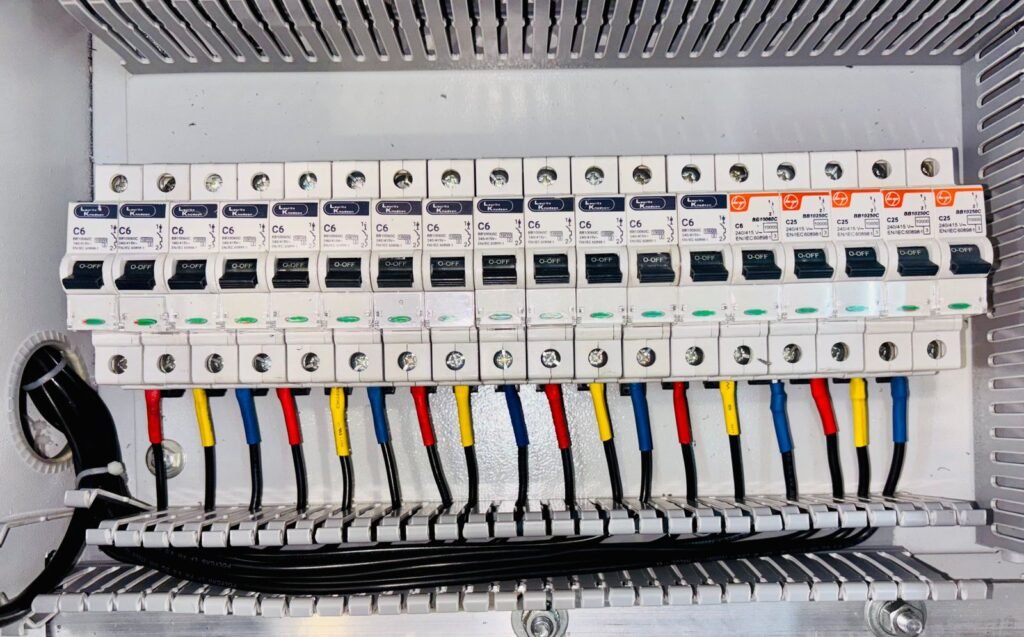 Distribution Equipment
Electrical EquipmentEnclosures for final distribution in commercial and light-industrial buildings, supplied empty or equipped.
IP40 / IP65 · flush or surface · 1–4 rows
 Commercial Lighting
LightingRecessed or surface-mounted panel for offices, schools, healthcare and retail ceilings.
40 W · UGR < 19 option · flicker-free driver
 Industrial Lighting
LightingRobust UFO-style high bay for warehouses, factories and logistics centres, available with multiple optics and dimming options.
150 W · up to 160 lm/W · IP65 · 4000K / 5000K
 Generators
Industrial EquipmentStandby and prime-power generator sets for sites, commercial buildings and industrial facilities.
20 kVA prime · silent canopy · ATS option
Need a different size, standard or quantity? Request a quote